The Mediterranean Sea has been the womb of the development of
Western civilization. Though the development of our culture has been
a complicated process including influences eg. from Mesopotamia and
Egypt, many historians emphasize that the development of European
culture for a great deal took place on the island of Crete in the
Mediterranean Sea in the palace of Knossos.
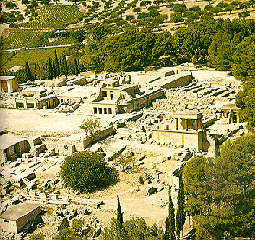
Knossos
The first palace was built there some 4000 years ago. Since that
several other palaces were built in the same location and in other
parts of the island.
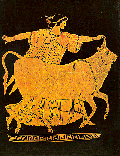
It was to this island where the Greek God Zeus took the
beautiful princess Europa. Zeus had taken the form of white bull, he
approached Europa when she was picking flowers with her friends.
Europa sat on the back of Zeus who took her to Crete and married her.
From the princess Europa the whole continent Europe got its name.
Why is Knossos so central in the development of Western culture.
The reason is evidently that it is in the center of the Mediterranean
Sea. The sea gave the possibility for travelling and connecting
people and thus the possibility for making trade and for exchanging
cultural influences. The trade increased the standard of living and
did help in developing the culture which received important
influences from different nations.
Why do I start the opening address of a Nordic-Baltic Conference
from the Mediterranean Sea and from the island of Crete? The reason
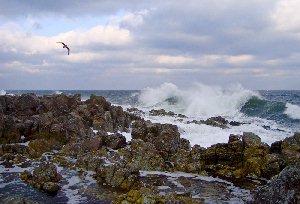
is, that in the same way the Baltic Sea has been the womb of the
development of the economic welfare and civilization of the Nordic
and the Baltic States around it.
Around the Baltic Sea there has been a rich cultural development
since the withdrawal of the ice bed which covered these areas some
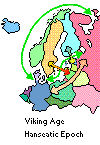
10.000 years ago. The Vikings made long journeys making trade with
people far into the present Russia in the Novgorod area and they
actually governed those regions for a while. It is also known that
the Vikings were the first Europeans who made the journey to America.
The strong economic development period of the Baltic Sea region
took place from the beginning of our millennium. This was based on
trade made mainly through transporting merchandise along the sea.
This time was called the Hanseatic Epoch.
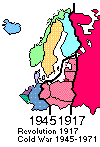
In the beginning of this century the contacts between the Nordic
Countries and Russia were suddenly discontinued for political
reasons. A little later the connections to the Baltic States were
also discontinued. During that time the co-operation between the
Nordic Countries was active, but scientific contacts to the Baltic
States did not in practice exist.
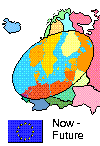
Now we live a new era. The Baltic States are with us again. And
I claim, that from this time on, there is no real Nordic co-operation
without the Baltic States. All we who live around the Baltic Sea have
similarities in history, society, economic and cultural life. We
should work jointly. Then we form a strong unit in the international
community.
In the Nordic Countries the first national society for medical
physics and biomedical engineering was established in Sweden in 1956.
That was followed by the societies in Norway and Poland in 1967, in
Finland in 1968, in Germany in 1971 and in Denmark in 1972.
From the initiative of Professor Erik Spring there was started
a series of Nordic Meetings of Medical and Biological Engineering.
The first one of these was organized in Finland in Espoo, close to
Helsinki, in 1970.
From then on these conferences were organized in the Nordic
Countries as follows: Oslo, Norway, 1971; Tampere, Finland, 1975;
Lyngby, Denmark, 1977; Linköping, Sweden, 1981; Aberdeen, Scotland,
1984; Trondheim, Norway, 1987; Ålborg, Denmark, 1990; and Lund,
Sweden, 1993.
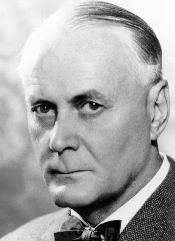
This slide was taken from the First Nordic Meeting in Espoo in
1970. You may see Professor Ragnar Granit, the inaugural speaker of
the conference, on the right.
In this connection we have to remember that in 1985 it was
organized in Finland the World Conference on Medical Engineering and
Medical Physics.
After the Lund conference it was Finland's turn to organize the
next Nordic conference. For some time there has been a discussion on
whether it is necessary to have a series of Nordic conferences
because there already exist so many different series of conferences
in the field of biomedical engineering in the world.
About at the time of the Lund conference the political situation
has changed around the Baltic Sea. In Estonia a national society was
established in 1994 and thereafter in Latvia and Lithuania in 1995.
In Iceland there was also established a national society in 1994.
Thus now when this 10th Nordic conference is held, there exist
four new national societies in the Nordic-Baltic region. Therefore
the Ragnar Granit institute wanted to apply to the Finnish Society
for Medical Physics and Medical Engineering for the rights to
organize this conference under the name "10th Nordic-Baltic
Conference on Biomedical Engineering". In this completely new
situation I see that there is no doubt that the tradition of Nordic
conferences on Biomedical Engineering is perhaps stronger than ever
before! But now it is under the name Nordic-Baltic. The concept
Nordic-Baltic has returned to its original meaning. This is why we
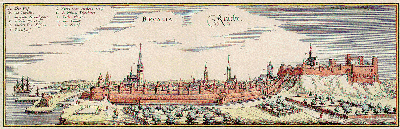
selected the famous map of Olaus Magnus and A. Lafrieri of the
Nordic-Baltic region to symbolize the conference in all its publicity
material.
This conference is the largest of the Nordic conferences on
biomedical engineering. The total number of papers is about 350. The
conference also includes 13 high-quality State-of-the-Art lectures
given by famous scientists from all around the world, one of them
being Nobel Laureate Ivar Giaever. The papers come, of course, from
all Nordic and Baltic countries, from Western, Central and Eastern
Europe, USA, South America, Near and Far East and Australia.
Altogether some 36 countries are represented within the scientific
papers and other active participants. The number of active
participants is about 400 plus their accompanying members.
One may ask is this a Nordic-Baltic Conference if one half of
the papers come outside this region? Isn't it rather a World
Conference? My answer is, that this is a Nordic-Baltic conference
where the scientists in the Nordic-Baltic region have an excellent
opportunity not only to communicate between each other but also to
communicate with colleagues around the world.
The Organizing Committee is very glad to see that the
participation from the Baltic States, Poland, Russia, Belorus and
Ukraine is so active. We have been willing to encourage participants
from these countries to come to Tampere by awarding them a grant
which has covered almost one half of the registration fee. The number
of these grants was altogether about 60. Some 25 of these were made
possible by a generous donation from the President of the IFMBE,
Professor Fumihiko Kajiya. The rest of them were given by the Ragnar
Granit Foundation. The Organizing Committee gives its warmest thanks
to Professor Fumihiko Kajiya!
We wanted to extend the perspectives of this conference both
with satellite symposia and tutorial courses. Organizing a
preconference satellite symposium in Lapland by Oulu University gave
the opportunity for the participants of that symposium to extend
their experience in technology transfer between research institutes
and industry.
I guess having a scientific symposium in the midnight sun must
have been an unforgettable experience which cannot be offered by many
other countries than Finland.
The scientific program of this conference continues immediately
on Thursday in Tallinn, Estonia in a postconference satellite
symposium. The high-quality scientific program in that symposium
combined with unique atmosphere of an old Hanseatic city should give
a valuable conclusion to this series of scientific events of the
Nordic-Baltic conference.
We have also wanted to serve the young participants of this
conference with four preconference tutorial courses. Having several
internationally recognized experts participating in our conference
has given a unique opportunity for organizing these tutorial courses
whose topics represent various important aspects of biomedical
engineering and bioelectromagnetism.
This conference is a joint conference of the 10th Nordic-Baltic
Conference on Biomedical Engineering and the 1st International
Conference on Bioelectromagnetism. The Scientific Committee of the
conference made the decision on this organization on the following
basis:
The bioelectric phenomena are a vital part of living organisms
processing and transferring important information within the body
organs, as well as between the body and the environment, and in
controlling the contraction of the muscles.
In the congresses of biomedical engineering there has been a
great number of scientific papers on bioelectricity and biomagnetism.
To emphasize the importance of these phenomena, and especially that
they are complementary techniques and should be discussed jointly,
it was decided to start a new series of international conferences on
bioelectromagnetism.
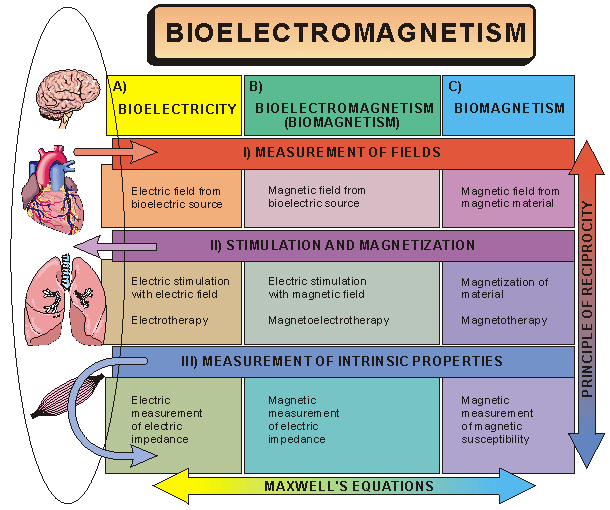
I will very briefly introduce you the discipline of
bioelectromagnetism. It may be divided into three by three
subdivisions in the following way:
The electric activity of tissue produces an electric potential
field which can be measured. Electric current in a volume conductor
induces a magnetic field that can be measured around the volume
conductor. Furthermore there may exist magnetic material in the body
which generates a measurable magnetic field.
Examples of this subdivision are for instance electrocardiography, i.e. recording the
electric activity of the heart.
Modelling the thorax with a computer model gives tools for
developing new electrocardiographic leads. This gives a possibility
to improve the diagnosis of cardiac diseases. This and the next
example are representative research results made at the Ragnar Granit
Institute.
This figure illustrates the calculated distribution of electric
activity of the brain. It is made on the basis of electric potentials
recorded from the scalp. This kind of analysis gives much more
accurate image on the function of the brain than the traditional
electroencephalography, EEG, and gives more accurate basis for
diagnosing brain diseases.
The nerve and muscle tissue may be excited by feeding electric
current to the body. This is called stimulation. Stimulating current
may also be induced to the body by applying an alternating magnetic
field to it. And finally, magnetic material in the body may be
magnetized by applying magnetic field.
Examples of this subdivision are electric and magnetic
stimulation of the brain, as in this slide. Another important
application is the cardiac pacemaker.
The third set of subdivisions concerns measuring the intrinsic
electric and magnetic properties of the tissue. Impedance cardiography,
which is a nonivasive measurement of the mechanical activity
of the heart, is a representative example of this third subdivision.
Because of the principle of reciprocity, the same thorax model which
I showed before may also be used for developing new methods to
utilize the thorax impedance measurement in improving cardiac
diagnosis.
In the discipline on bioelectromagnetism, the very important
feature is that all these nine subdivisions are strongly interconnected
through two important laws which are: Maxwell equations and
principle of reciprocity. This means that if the situation is known
in one of these nine cases, the corresponding situation can be
calculated in all other eight cases on the basis of the
aforementioned laws. This fact makes the discipline very solid.
This conference is organized by the Ragnar Granit Institute and
the Ragnar Granit Foundation. This certainly should give a good
reason to tell more about Ragnar Granit.
Ragnar Granit was born at Riihim„ki close to Helsinki in 1900.
He studied medicine at Helsinki University and completed his MD
thesis in 1926 on the theory of color vision.
In this work he recorded the bioelectric signals from frog
retina with very small microelectrodes which he developed himself.
Thus he was a pioneer on recording the bioelectric phenomena.
Ragnar Granit visited the laboratory of Sir Charles Sherrington
in Oxford in 1928. From 1929 to 1932 Granit worked at Pennsylvania
University in Philadelphia and
then he returned to Helsinki to continue his research. At Helsinki
University he was appointed as Professor of Physiology in 1937.
In 1941 Ragnar Granit was invited to Karolinska Institute in
Stockholm and was appointed in 1945 as director of Neurophysiological
Laboratory of the Medical Nobel Institute. Later he travelled much
abroad serving for instance as visiting professor at the Rockefeller
University in New York 1956-1966. He retired in 1967.
In 1967, after his retirement, he received the Nobel Prize. But
what is important for us is that he received that mainly from the
works which he had done in Finland before moving to Sweden. Thus
Ragnar Granit is a Finnish Nobel Prize winner in addition to F. E.
Sillanp„„ who received the prize in literature in 1939 and A. I.
Virtanen who received it in chemistry in 1945.
Ragnar Granit died in 1991. In 1992 the Institute of Biomedical
Engineering at Tampere University of Technology was named as the
Ragnar Granit Institute to honor the life-work of Professor Ragnar
Granit. This was based on the permission of his family.
Organizing a conference on biomedical engineering and having a
worldwide participation in it is a great honor for Finland. We highly
appreciate this opportunity because biomedical engineering is an
important discipline in our country.
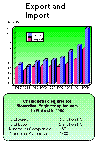
Finland has a strong industry in this field. There exist about
150 companies having some 4300 employees. The total sales of these
companies in 1995 was about 3.3 billion FIM. The strength of this
industry is characterized by the figures that the volume of the
export was 2.2 billion FIM and the import was roughly some 60% of
that. There exist companies whose export is over 95% of their sales
and is spread all over the world. The biomedical engineering industry
in Finland is, of course, mainly located in those cities where a
university hospital and university of technology or faculty of
medical physics exist.
As examples of the successful biomedical engineering industry
in Finland I might show the patient monitoring equipments.
Another example is the ortopantomograph device. It is used for
getting an x-ray image of the teeth. It is an example of a device of
whose production about 98% is exported worldwide.
I will give another two examples of biomedical engineering
products which are successfully produced at Tampere. One application
of bioelectromagnetism is electric stimulation of the phrenic nerve
of patients whose breathing muscles are paralyzed. This implantable
stimulator was initially developed at the Ragnar Granit Institute and
is now in industrial production at Tampere and sold worldwide.
Another example of successful industrial application is surgical
stents, screws and other devices made from bioabsorbable materials.
When the screws, which are used for fixing bone fractures, are made
from material which dilutes in the body, another surgical operation
for removing the screws is not needed and a lot of money, and of
course discomfort of the patient is saved.
Biomedical engineering education and research has a long
tradition in Finland. Tampere University of Technology is 30 years
old. It has had biomedical engineering education and research in its
program for the whole of its existence.
Just recently the City of Tampere has decided to start a strong
development program of biomedical engineering industry. The Ragnar
Granit Institute will continue to do its best for the success of this
program. We see that for instance this conference is an important
link in the development of international contacts, in research,
education and in industry.
What makes it important for a congress participant to come to
Tampere for an international congress? Tampere is an old industrial
city of Finland. Its early development was based on textile, wood and
pulp as well as heavy metal industry.
The new industrial Tampere has a character of high technology
which is strongly supported by the University of Technology.
Biomedical Engineering is a new, but important field of this High-Tech activity.
Tampere is unique in its geology and landscape. In Tampere you
may find the world's oldest rocks being over 1.5 billion years old.
From Tampere you may also find very young unique geological
formations: When you walk on the Pyynikki Ridge separating the two
lakes Näsijärvi and Pyhäjärvi you may experience the world's highest
gravel ridge created by the ice age. You may find it a unique natural
book of the geographical history of this region. You may also find
that here in the far North the summer nights are light and it never
gets dark.
You may find interesting art museums and unique architectural
landmarks. One masterpiece of those being the Cathedral where an
organ concert is arranged for the conference participants.
And especially to our Japanese colleagues I would like to remind
that do not forget the Moomin Museum!
Ladies and Gentlemen!
When we are now in a worldwide conference of biomedical
engineering, I cannot resist on informing you what is the most
successful and most widely used Finnish achievement in the
development of biomedical engineering.
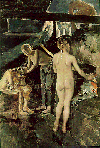
I do not think there is any other
such biomedical engineering achievement which, in addition to
promoting health and treating various diseases, having been for
hundreds of years the local obstetric clinic of each home, still
continues working well, bringing health and relaxation and good
spirit. I hope that you all, our foreign guest, have the opportunity
to experience this unique Finnish achievement of biomedical
engineering!
I hope that your visit to Tampere is successful, unforgettable
and relaxing, both professionally and personally!
 Cover Page


 Top of the Page